

What Is Oxivir TB Wipes? Uses, Key Benefits, and How It Works
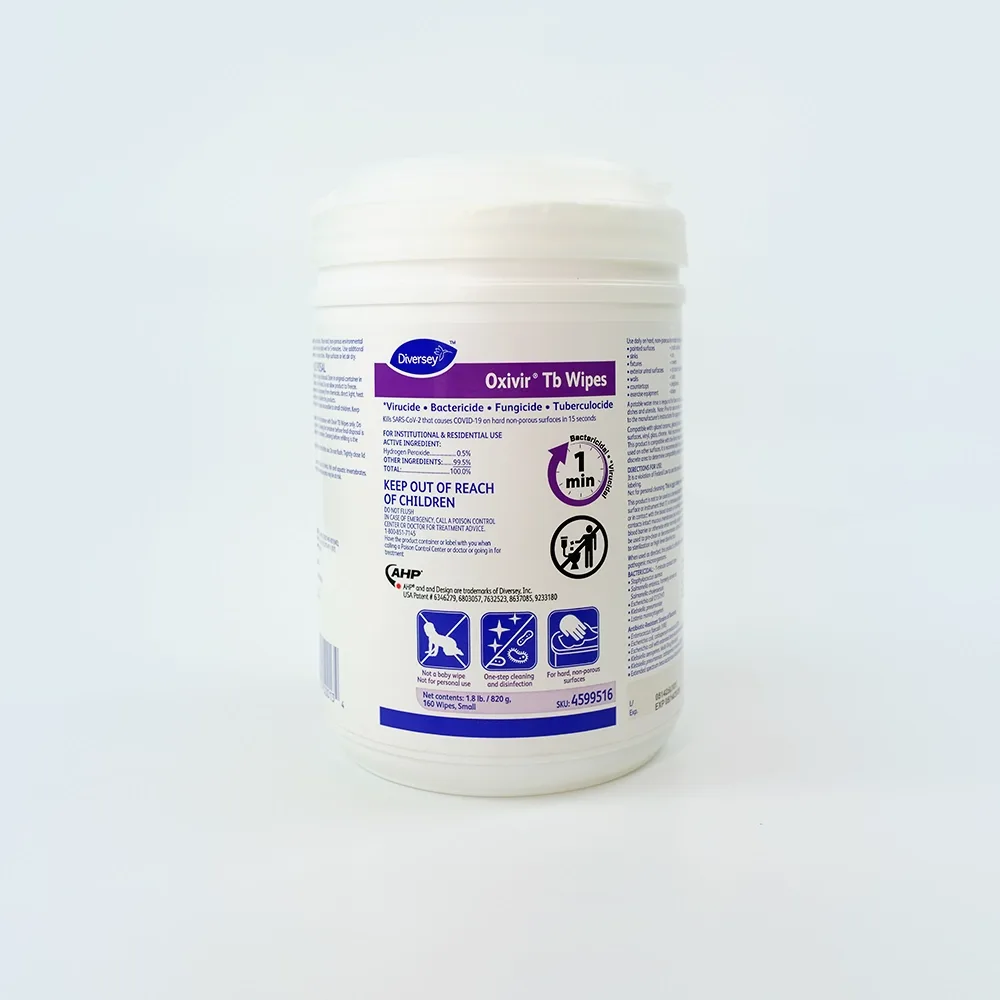
Oxivir TB Wipes are ready-to-use cleaning and disinfecting wipes from Diversey. They use Accelerated Hydrogen Peroxide (AHP®) technology and are designed for cleaning and disinfecting hard, non-porous surfaces in a single step.
Because the wipes are pre-wetted, there is no need to dilute or prepare a disinfectant solution before use. This also helps simplify routine surface disinfection, especially in areas where cleaning needs to be performed frequently.
What Can Oxivir TB Wipes Be Used On?
Oxivir TB Wipes are designed for use on hard, non-porous surfaces, such as external equipment surfaces, tables, countertops, and frequently touched surfaces.
AHP® technology has been tested for material compatibility across a wide range of materials. Materials rated A — Excellent, meaning no effect on material integrity was observed under the test conditions, include:
ABS Plastic
Acrylic
Ceramic
Polycarbonate
Polypropylene
PVC
Silicone
Stainless Steel 304 and 316
Teflon
Titanium
However, “hard surface” does not mean every material is equally compatible. The compatibility test uses ratings from A to D. For example, Copper and Carbon Steel are rated D and are not recommended for use, while Brass and Anodized Aluminum are rated C and are not recommended for continuous use.
This is especially important for surfaces that are disinfected repeatedly. When selecting a disinfectant, material compatibility should be considered alongside antimicrobial efficacy.
What Are the Key Benefits of Oxivir TB Wipes?
One-step cleaning and disinfection
Oxivir TB Wipes are formulated as a one-step cleaner and disinfectant, combining cleaning and disinfection in one product. Heavily soiled areas should still be pre-cleaned before disinfection.
Ready to use
Each wipe is pre-saturated with the disinfectant solution, eliminating the need for dilution or preparation before use.
Powered by AHP® technology
AHP®, or Accelerated Hydrogen Peroxide, is the core technology behind Oxivir products. The Oxivir TB Wipes formulation contains no VOCs, no added fragrance, and no NPEs. The hydrogen peroxide component ultimately breaks down into water and oxygen after use.
Why Does Contact Time Matter?
One of the most important factors in surface disinfection is contact time — the amount of time the surface must remain wet with the disinfectant to achieve the tested level of efficacy.
Oxivir TB Wipes have different contact times depending on the microorganism being targeted.
1 minute — many bacteria
5 minutes — Mycobacterium bovis
10 minutes — Trichophyton mentagrophytes
Candida auris was also tested at a 5-minute contact time, achieving a reduction greater than 5.36 log10 under the specified test conditions.
Contact time also matters in real-world use. Research highlighted by Diversey compared seven disinfectant products and found that the AHP® product tested had a 1-minute contact time while remaining wet for approximately 3 minutes.
By comparison, some products in the same study required a 10-minute contact time but dried in less than 4 minutes, making it more difficult to maintain the required wet-contact period in practice.
This means that when evaluating a disinfectant, it is useful to ask not only “Does it kill this microorganism?” but also “Can the surface realistically stay wet for the required contact time?”
What Microorganisms Has Oxivir TB Wipes Been Tested Against?
Oxivir TB Wipes have been tested against a range of microorganisms, including bacteria, viruses, Mycobacterium, and fungi.
Examples include:
Staphylococcus aureus
Pseudomonas aeruginosa
Escherichia coli O157
MRSA
VRE
Human Coronavirus
Influenza A
Rhinovirus
Rotavirus
Poliovirus
Mycobacterium bovis
Trichophyton mentagrophytes
For several viruses, efficacy is reported as log reduction. Under the specified test conditions, Human Coronavirus achieved ≥4.0 log10 reduction, Influenza A/Hong Kong ≥4.75 log10 reduction, and Norovirus — using Feline Calicivirus as the surrogate — ≥6.09 log10 reduction at a 1-minute contact time.
For this reason, it would be inaccurate to simply say that Oxivir TB Wipes “kill every microorganism in one minute.” Different organisms have different tested contact times.
How to Use Oxivir TB Wipes Effectively
The basic process involves four steps:
Pre-clean — Remove heavy soil before disinfection when necessary.
Wipe — Apply the wipe thoroughly across the hard, non-porous surface.
Keep Wet — Keep the surface visibly wet for the required contact time.
Air Dry — Allow the surface to air dry.
Food-contact surfaces must be rinsed with potable water after use. The product should not be used on glassware, utensils, or dishes.
Oxivir TB Wipes are a professional-use surface disinfectant and are not intended for disinfecting hands or skin. Under normal use conditions, the SDS states that no special eye, hand, body, or respiratory protection is required, and the finished product is not classified as hazardous.
More Than a Product Claim: Supporting Test Data
When evaluating a surface disinfectant, it is useful to look beyond the packaging and ask three practical questions:
What microorganisms has it been tested against?
How long does it need to remain wet?
Which materials is it compatible with?
Oxivir TB Wipes are supported by several types of technical information:
Efficacy Testing — antimicrobial efficacy against multiple microorganisms
Material Compatibility — compatibility testing across a range of materials
Safety Data Sheet (SDS) — safety, handling, and storage information
Together, these documents provide a more complete basis for evaluating the product than relying only on the phrase “disinfectant wipe.”
Summary
Oxivir TB Wipes are ready-to-use cleaning and disinfecting wipes powered by AHP® technology. Their key strengths include combining cleaning and disinfection in one step, relatively short contact times for many tested microorganisms, and supporting data on both antimicrobial efficacy and material compatibility.
However, effective disinfection depends on more than choosing the right product. Three factors should always be checked before use: the surface material, the target microorganism, and the required contact time.